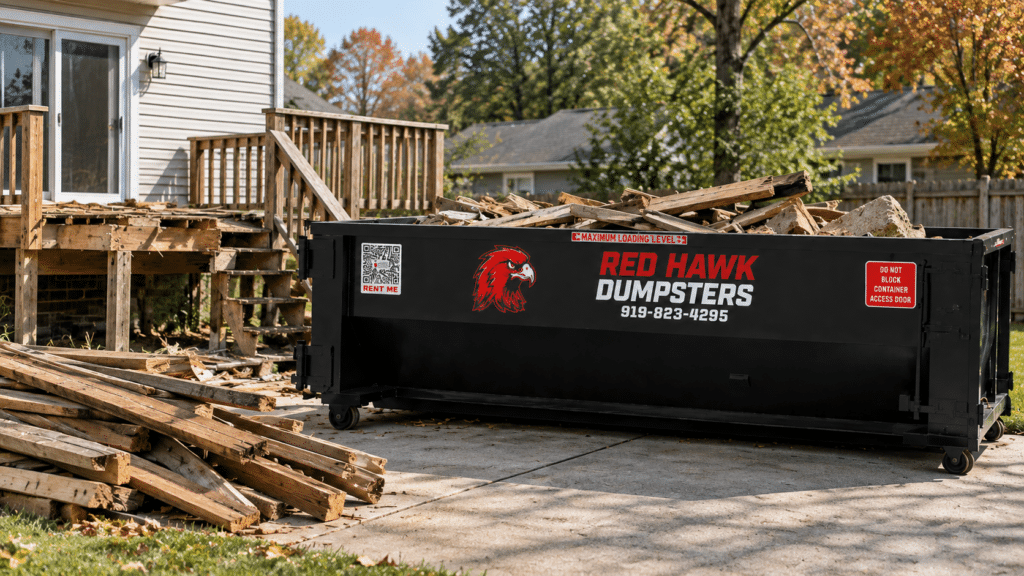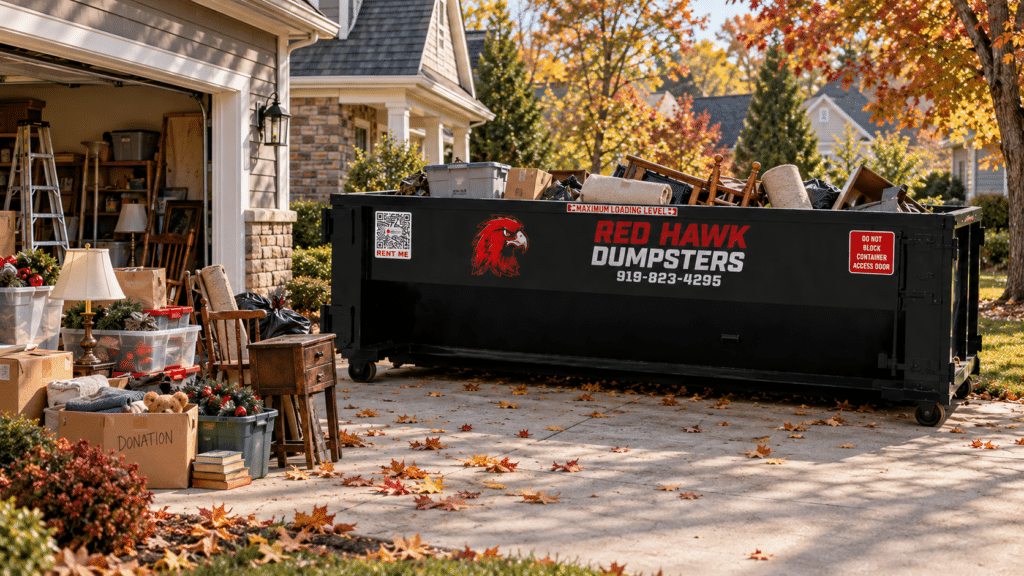
Sorting, donating, and disposing of decades of accumulated belongings is the hardest part of an estate cleanout — and the right dumpster keeps the remaining household junk and bulky furniture moving off the property efficiently.
The best approach to an estate cleanout in Raleigh is to inventory the entire property first, separate belongings into keep, donate, sell, special-disposal, and dumpster categories, identify restricted materials like paint and batteries before loading begins, and then choose a dumpster sized to the full volume of remaining household junk and bulky furniture. A 20-yard container handles a partial cleanout, while a 30-yard dumpster is typically the better fit for a whole-house estate cleanout spanning multiple rooms, a garage, an attic, and a basement. Walk every room and storage area before ordering anything, then schedule a dumpster with Red Hawk Dumpsters sized to the complete property.
Why Estate Cleanouts Are More Complicated Than Ordinary Decluttering
An estate cleanout is rarely the same as clearing out a single cluttered room. A property that has been lived in for decades holds layers of accumulated belongings — furniture from multiple eras, boxes of clothing, kitchen goods, holiday decorations, paperwork, tools, garage contents, attic storage, basement clutter, and items that were meaningful to the person who lived there. The volume often surprises the family handling it.
Raleigh families and executors search for an estate cleanout dumpster rental when they are preparing an inherited property, clearing a home for sale, downsizing a family residence, or trying to finish a cleanout before the holidays bring visitors and travel. Each of those situations carries its own deadline. A property listing has a closing date. A holiday gathering has a fixed calendar. And the emotional weight of sorting through a family member’s belongings makes the process slower than a typical home project.
The practical problems stack up quickly. Bulky furniture fills a dumpster faster than expected. Repeated dump runs consume entire weekends. Prohibited materials mixed into the load create disposal complications. A container placed too far from the house turns every trip into a long carry. And without a clear sorting plan, the timeline stretches well past the original estimate.
What Families Overlook When Cleaning Out an Estate
The biggest mistake in many estate cleanouts is treating everything in the property as a single category of waste. In reality, the belongings in an estate fall into several distinct groups, and each one needs a different destination. Items being kept by family members should be set aside first. Usable furniture, clothing, and household goods should go to a donation pile. Valuable items may be sold through an estate sale or resale. Restricted materials — paint, solvents, chemicals, batteries, propane cylinders, and refrigerant-containing appliances — require separate disposal through approved channels. Only what remains after all of that belongs in the dumpster.
A second gap involves how quickly bulky household items consume container space. Furniture, shelving, storage bins, mattresses, and rugs are light relative to their size, which means they fill a dumpster by volume long before they approach a weight limit. A couch that weighs 150 pounds can still eat up a quarter of a 20-yard container if it is loaded whole. Breaking furniture down — removing legs, separating sections, and flattening what can be flattened — lets the container hold significantly more without requiring a second haul.
The third overlooked factor is identifying restricted materials before the cleanout begins. Discovering paint cans, old batteries, or a refrigerator in the basement after the dumpster is already being loaded creates a second cleanup task on top of the first. North Carolina hazardous waste disposal rules do not allow those items in a standard roll-off container, and a contaminated load can be refused at the facility. Walking the property for restricted materials first prevents that outcome entirely.
Planning the Dumpster Rental for an Estate Cleanout
Sizing a dumpster for an estate cleanout depends on the number of rooms and storage areas being cleared, the quantity of furniture and bulky items, and whether the project is a partial cleanout or a whole-property effort. A partial cleanout — several rooms, a garage, or an attic and basement — often fits in a 20-yard container, which holds roughly seven to eight pickup-truck loads. That is enough capacity for a significant amount of furniture and household junk without jumping to the largest available size.
A whole-house estate cleanout is a different calculation. When the project spans every room plus a garage, attic, basement, and shed, a 30-yard dumpster is typically the more reliable choice. The larger container reduces the chance of running out of space while bedrooms and storage areas are still being cleared. Homeowners can review the 20-yard dumpster rental option alongside the 30-yard alternative to compare which fits the full scope of the property.
Placement matters as much as size. An estate cleanout involves carrying items out of every room in the house, so the dumpster should sit where the carry distance is shortest — usually a driveway position near the front door. Red Hawk provides driveway protection boards to prevent surface damage. If the property has narrow access or is on a street where placement is restricted, confirming the drop location in advance keeps the project from stalling on delivery day.
Actionable Steps to Organize an Estate Cleanout
How Starting Without a Plan Extends an Estate Cleanout for Weeks
Beginning an estate cleanout without sorting first can result in valuable, sentimental, or donatable belongings becoming mixed with actual waste. Once a couch, a box of photographs, and a bag of trash end up in the same pile, separating them again takes more time than the original sort would have. That kind of mixing turns a straightforward disposal project into a slow, careful second pass through material that was already handled once.
Choosing a dumpster based only on the visible trash in the living room can leave the container full while bedrooms, the garage, the attic, and the basement still need to be cleared. Large pieces of furniture loaded whole consume usable space quickly, and the family is left deciding whether to schedule a second container or let the remaining items sit while they figure it out. Either way, the timeline extends.
Waiting until late in the project to identify restricted materials creates another cleanup task after everything else has been removed. Paint cans found behind the basement shelf, a propane tank in the garage, or an old refrigerator in the carport each require separate disposal, and none of them can go into the dumpster that is already sitting in the driveway.
The holiday season adds its own pressure. A cleanout that needs to be finished before Thanksgiving, Christmas, winter travel, or a property listing has a hard deadline, and shorter daylight hours in October and November reduce the working window each day. Cooler fall weather also makes outdoor loading and pickup access something to organize before the project begins rather than once it is underway. Families can compare container sizes and rental periods through Red Hawk’s Triangle dumpster rental pricing to lock in the right option before the clock starts running.
Complete the Estate Cleanout Before the Holiday Season
A successful estate cleanout starts with sorting the property before anything goes into the dumpster. Belongings should be separated into keep, donate, sell, special-disposal, and disposal categories. Restricted materials should be identified before loading begins. The dumpster should be sized to the full property — not the first few rooms — because bulky furniture and household junk consume container space faster than most families expect. A 20-yard container handles a partial cleanout, while a 30-yard dumpster is the safer choice for a whole-house effort.
Red Hawk Dumpsters is a locally owned roll-off dumpster rental company based in Raleigh, serving families, executors, and property managers throughout Wake County and the greater Triangle. The company offers multiple dumpster sizes, driveway protection, upfront pricing, online booking with a 5% discount, and same-day delivery when available.
If an estate cleanout is on the schedule before the holidays, the practical next step is to walk the entire property, estimate the full debris volume, separate restricted materials, and reach out to Red Hawk to confirm the right container size and delivery date while there is still time to finish comfortably.
No protective method completely eliminates the possibility of surface damage, and customers with older, cracked, thin, or otherwise questionable surfaces should discuss placement with the dumpster provider before delivery. Red Hawk’s placement and booking guidance in the dumpster rental FAQ covers many of these practical questions, and the company can help you think through surface concerns when you book.
KEY TAKEAWAY
A successful estate cleanout starts with sorting the property into keep, donate, sell, special-disposal, and dumpster categories before anything is loaded. Bulky furniture and household junk consume container space quickly, so the full property — not just the first few rooms — should be considered when choosing a dumpster size, with a 20-yard container for partial cleanouts and a 30-yard dumpster for whole-house efforts. Hazardous or restricted household materials like paint, batteries, and refrigerant appliances must never be mixed into the general debris. The practical next step is to estimate the cleanout volume across the entire property and choose the appropriate dumpster before the main cleanup begins.
Frequently Asked Questions
What size dumpster do I need for an estate cleanout?
A 20-yard dumpster handles a partial estate cleanout — several rooms, a garage, or a combination of furniture and household junk. A 30-yard container is typically the better choice for a whole-house cleanout involving multiple bedrooms, living areas, a garage, an attic, and a basement all at once.
Can furniture go in a dumpster during an estate cleanout?
Yes. Couches, chairs, tables, dressers, shelving, bed frames, and other bulky household furniture are accepted as general debris. Breaking down furniture when practical — removing legs, separating sections, and flattening what can be flattened — helps the container hold more without requiring a second haul.
Can mattresses go in a roll-off dumpster?
Mattresses and box springs are generally accepted, though some facilities assess a small per-unit surcharge at disposal. Confirming the quantity with Red Hawk before loading lets the company account for any disposal fees upfront rather than at pickup.
What household items cannot go in an estate cleanout dumpster?
Paint, solvents, chemicals, batteries, propane tanks, tires, and appliances containing refrigerant are prohibited or restricted. These items require separate disposal through approved channels and should be identified before the cleanout begins rather than discovered mid-load.
How do you clean out an estate before selling a house?
Walk the entire property first, separate belongings into keep, donate, sell, special-disposal, and dumpster categories, and then order a container sized to the full property rather than the first few rooms. Positioning the dumpster for short carry distances keeps the project moving toward a closing or listing deadline.
Book Your Raleigh Estate Cleanout Dumpster
Red Hawk Dumpsters serves estate cleanouts and whole-home junk removal across Raleigh and the Triangle.
NC Licensed & Insured * Same-day delivery available. Book online or call before noon.